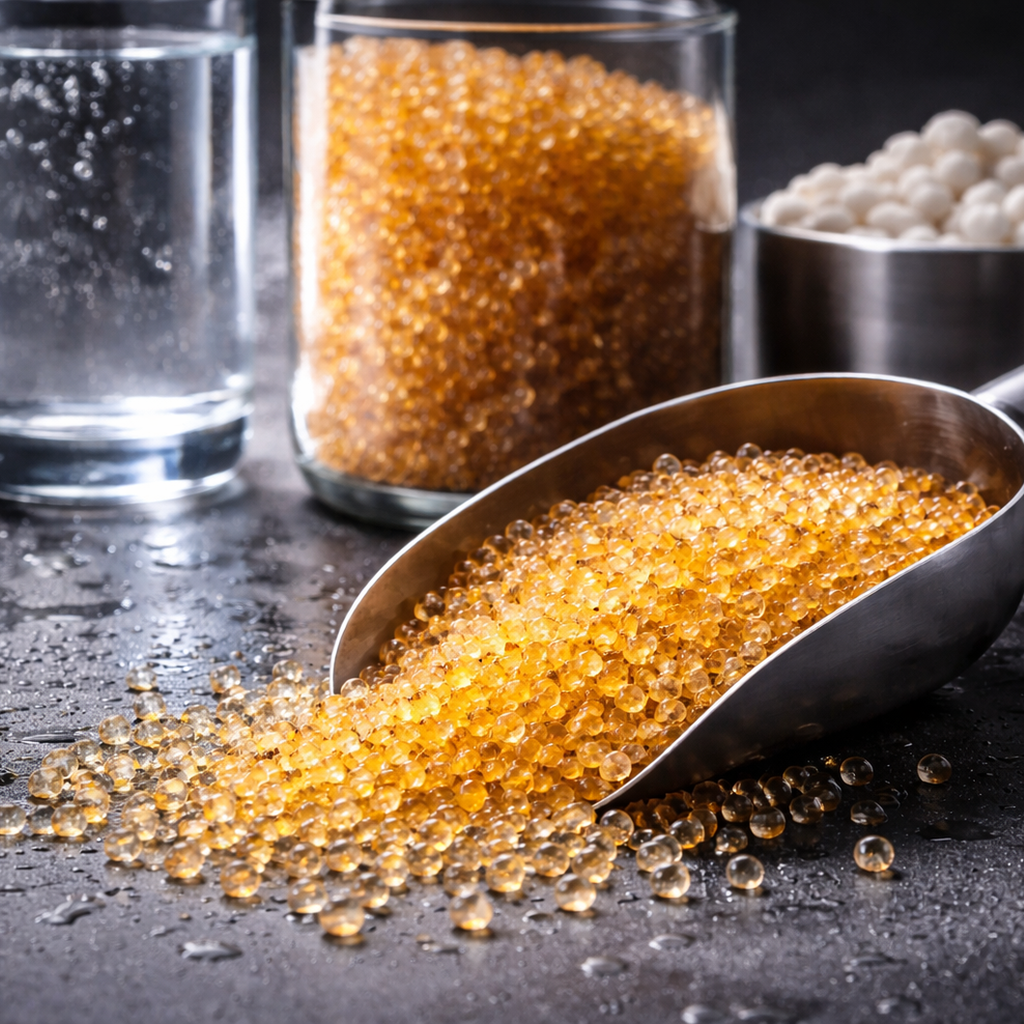
8% Crosslink Strong Acid Cation Exchange Resin (1 Cubic Foot)
This 8% crosslink strong acid cation exchange resin is designed for efficient hardness removal in residential, commercial, and industrial water softening systems. The resin is manufactured from a styrene–divinylbenzene copolymer matrix with sulfonic acid functional groups and is supplied in the sodium form for immediate use in standard softening applications.
The resin works through ion exchange, replacing hardness minerals such as calcium and magnesium with sodium ions, effectively reducing scale formation in plumbing systems, boilers, and equipment. Its balanced crosslink structure provides reliable mechanical strength, good resistance to fouling, and long service life in a wide range of water treatment conditions.
This resin is commonly used in potable water treatment, food and beverage processing, and general industrial water softening systems.
Features
- Strong acid cation exchange resin designed for hardness removal
- 8% crosslink structure for reliable durability and performance
- High ion exchange capacity for efficient softening
- Uniform bead size distribution for consistent flow and regeneration
- Excellent mechanical strength and chemical stability
- Suitable for potable water and food processing applications
- Wide operating pH range
Applications
- Residential water softeners
- Commercial water softening systems
- Industrial water treatment
- Boiler feed water softening
- Food and beverage processing water treatment
- Pre-treatment for reverse osmosis systems
Resin Characteristics
- Appearance: Golden yellow to brown spherical beads
- Matrix: Styrene–divinylbenzene copolymer
- Functional Group: Sulfonic acid
- Ionic Form (as supplied): Sodium
Physical Properties
- Total Exchange Capacity: Minimum 2.0 meq/ml
- Moisture Content: 43 – 50%
- Shipping Weight: 810 – 850 kg/m³
- Particle Size Range: 0.3 – 1.2 mm
- Uniformity Coefficient: Maximum 1.7
- Effective Size: 0.45 – 0.60 mm
Operating Conditions
- Maximum Operating Temperature: 120°C
- Operating pH Range: 0 – 14
- Resistance to Reducing Agents: Good
- Resistance to Oxidizing Agents: Generally good; free chlorine should be minimized
Impurity Limits
- Iron: 100 mg/L maximum (as Fe)
- Heavy Metals: 20 mg/L maximum (as Pb)
- Arsenic: 3 mg/L maximum (as As)
Organic Extractives:
- Maximum 1 mg/L in deionized water
- Maximum 1 mg/L in 15% ethanol solution
Recommended Startup Procedure
After filling the service vessel, the resin bed should be thoroughly rinsed with approximately 20 bed volumes of deionized water to remove any residual organic leachables. This procedure is typically required only during initial installation or after extended shutdown periods.
Storage
Resin beads must remain moist at all times and should never be allowed to dry out. Store in sealed containers or bags in a cool, shaded environment away from direct sunlight.
Safety
Acid and alkaline solutions used during regeneration are corrosive and should be handled with appropriate safety precautions. Avoid contact with skin and eyes. When oxidizing agents are used, proper care should be taken to prevent resin degradation.
Packaging Options
- HDPE lined bags: 25 L or 50 L
- LDPE bags: 1 cubic foot / 25 L
- Super sacks: approximately 1000 L (35–42 cubic feet)
- HDPE or metal drums with liner bags: 180 – 200 L
- Fiber drums with liner bags: approximately 7 cubic feet
Certifications
Commonly tested and certified to NSF / ANSI / CAN 61 for potable water contact and NSF / ANSI 372 lead-free compliance depending on supplier specifications.